




Factories and business are asking for help
Facing the risk posed by the proposal of “The National Program to Eliminate Asbestos-Related Diseases” with the goal to stop the use of chrysotile fiber in the production of roofing sheet by 2020, a series of enterprises and factories have sent their petitions to the Government, the National Assembly and the authorities asking for a stable policy of investment and production.
According to the study “The impact of Chrysotile ban in Vietnam – The case of asbestos cement roof sheet industry” conducted by the Central Institute for Economic Management – Ministry of Planning and Investment, if the enterprises switch to PVA fiber technology, the total cost will be up to 395 billion dong; the total amount of money spent by the Government will be 454.5 trillion dong; and consumers will have to pay 183.5 trillion dong for replacing AC roof sheet by PVA one including the roof sheet dismantling and the price difference expenses.
For the past dozens of years, when the ban on chrysotile hovering above the head, businesses have invested in researching on alternative materials technology, but the results do not turn out to be positive.
Dong Anh Investment, Construction and Building Materials Joint Stock Company has twice tried to produce non-chrysotile fiber roofing sheets using PVA in 2001 and 2014. However, they failed because the products did not meet the criteria of quality and price.
Besides, there are also two other factories that have tested non-chrysotile technology, but now Navifico has been shut down. Whereas, Tan Thuan Cuong has switched to produce AC roof sheet for its own existance. According to the report of Tan Thuan Cuong factory, it was established in 2008 with the initial purpose of producing non-chrysotile roofing sheet. However, as this product is not greatly welcomed by the domestic market, thus it only accounts for 5% of the total output. As a result, the enterprise must shift to produce AC roof-sheet to secure the operation and workload for the workers.
Long-term debate on Chrysotile
In Vietnam, the studies conducted by regulatory agencies have not detected any cases of mesothelioma associated with chrysotile.
In 2009-2011, the Ministry of Health had also carried out a Ministrial level study called “The research on asbestos-related diseases in exposed people”. Although being supported by Hospital of Hiroshima – Japan in terms of equipment and expertise, the study did not identify any cases of mesothelioma associated with chrysotile.
In 46 cases of mesothelioma patients, the number of patients with non-occupational asbestos exposure was 6 cases (13%), in which none of whom have exposed to chrysotile occupationally.
Compared to the results of some offshore studies in which 75-80% cases of asbestos-related mesothelioma have exposed to asbestos, this research showed an absolutely lower rate of risks posing by asbestos exposre. One possible explanation for this finding is that the patients are not exposed to amphibole, which poses a much greater risk than chrysotile. Whereas, chrysotile is the only one used in Vietnam since the early 1960s.
Notably, of the 46 mesothelioma cases, all 26 male patients, accounting for 56.53%, had a history of smoking; 100% of smoking cases have a suction time of more than 10 years. In the mesothelioma female cases, 20 of them did not smoke. This finding coincides with the conclusion of most domestic and international studies that cigarettes are the main cause of 90% of lung cancers, including mesothelioma, etc.
Currently, imported products containing chrysotile are an essential source of supply for the lives of the Vietnamese people. Imported products containing chrysotile include asbestos-coated, asbestos fire insulation, asbestos fabrics for electrolysis of thermal power plants, heat-resistant fibers, etc.
Pure chrysotile is imported in the form of powder; long fiber is used in the manufacture of roofing sheets, water pipes, automotive brake pads, heat – sound insulation, shipbuilding and ship repair and especially the asbestos cement roofing industry.
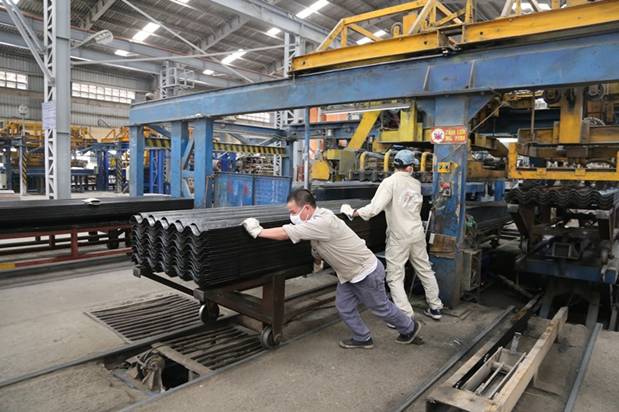
This industry has existed for more than 50 years with 39 manufacturing facilities with designed capacity of more than 110 million square meters per year, employing over 5,000 workers. AC roofing is resistant to extreme weather conditions with a long durability from 30 to 50 years, and its price is only one-third of a 0.4 mm thick galvanized one and is 40-50% lower than those of roofing using alternative fiber.
Reporter