




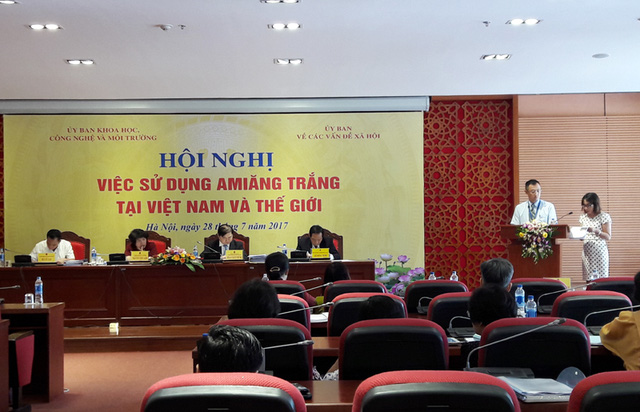
On 27 July, the National Assemby Committee on Science, Technology and Environment and Committee on Social Affairs co-hosted the Conference on the use of chrysotile in Vietnam and in the world.
Although Japan has banned chrysotile, Vietnam still imports Japan-made chrysotile containing products
In the conference, Mr. Le Hong Tinh – The Deputy Chairman of the Committee on Science, Technology and Environment raised the question of “why many developed countries such as the United States and Russia still use chrysotile in many industries. Don’t these countries care about human health?”
According to Mr. Tinh, we should research on this issue since chrysotile is allowed to used in many big and populated countries such as India, China, and Asean countries.
He added that after researching on the cases of countries banning the use of chrysotile, the Committee has noticed that the historical reason played an important role in the ban. During the WWII, Japan had used all forms of chrysotile including imphibole in weapon manufacture and shipbuilding. Consequently, many people have suffered from cancer due to exposure to amphibole.
As for chrysotile substitute products, the Committee has visited and evaluated the situation in different factories in Hai Duong and Nam Đinh. In fact, the high price and lower quality make the product less affordable to most users. As a reason, the factory has to produce AC roof sheets to survive.
The Deputy Chairman also raised a noticable question on the “ban”. There have been many houses with chrysotile roofing built in the framework of porverty reduction programmes such as the Programme No.135 and No.167, if the ban is imposed, will the Government replace billions of AC roofing?
He also emphasized that any policy making plan should include its economic impact assessment and feasibility evaluation.
Mr. Tinh thought that the issue should be studies comprehensively with the participation of different ministries such as Ministry of Health, Ministry of Foreign Affairs, Ministry of Planning and Investment to evaluate the healh impact of chrysotile and social-economic impact of the ban.
Russia, the United States vs Japan and Australia – who is more trustworthy?
According to Mr. Nguyen Phu Hoa, The Deputy Head of the Department of Industry – the representative of Central Economic Committee, the CEC had requested the Ministry of Health and four other Ministries to report on this issue.
However, the report have not provided sufficient information to answer the questions such as whether the ban targets chrysotile in AC roof sheet production or all chrysotile containing products in general? If the ban is only imposed on AC roof sheet industry, it will eradicate a domestic industry but still allow the import of chrysotile containing products from other countries?
If the ban is applied to all chrysotile using industry, is it possible especially when chrysotile is vastly used in insulation products, friction materials such as brake pads, brake linings and buidling materials?
Quoting the study conducted by the Central Institite of Economic Management (CIEM), he pointed out the significant impact of the ban. The AC roof sheet industry will have to pay VND 400 billion for technology transition. Especially, the replacement and disposal of chrysotile containing watse will cost the users and Government VND 200,000 billion.
Ms. Bui Thi An – the Deputy of the XIII National Assembly brought up the story of firecraker ban 20 years ago as an example. At that time, the jobs and livelihoods of people in this sector was a hugh concern to many authorities due to the risk of 2 million people losing jobs. However, the Gorvernment handled the issue successfully. Therefore, 5,000-6,000 workers in AC roof sheet factories should not be a big deal.
Canada was one of the biggest producers of chrysotile, although they have benefited greatly from the industry, they have declared to stop the producting and use of chrysotile by January 2018.
According to Ms. An, Australia has been paying a tremendous price for chrysotile use. Hence, the material has been forbidden in this country. She suggested the Government to visit Japan and Australia for research instead of chrysotile exporting countries such as Russia and Karzakhstan.
However, in respond to her speech, many people pointed out that Australia and Japan have been widely promoted the chrysotile substitute fiber, how could we ensure that the research would be objective?
P.Thảo